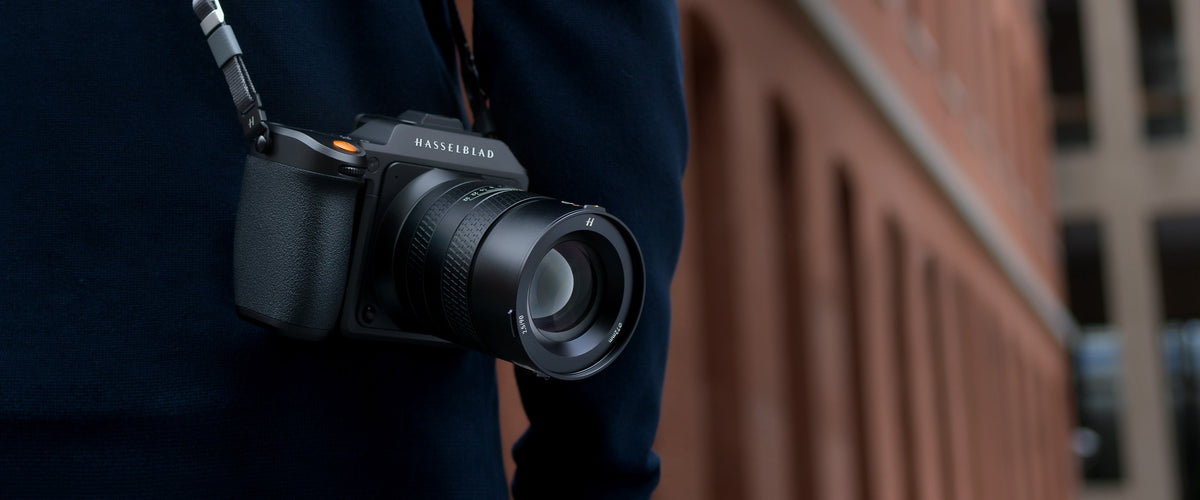
Choosing a camera for architectural photography starts with the images you intend to produce. Key considerations include resolution for detailed images and large prints, dynamic range for challenging lighting, perspective control for architectural geometry, and lens compatibility for different spaces and subjects.
A high-resolution full-frame camera can be a practical choice for many architectural assignments. A 100MP medium format system offers additional image detail for demanding output requirements, while compatible technical camera configurations support specialized framing and perspective adjustments.
The appropriate system depends on the architecture, shooting conditions, and final image requirements.
What to Look for in a Camera for Architectural Photography
A camera for architectural photography should provide sufficient image quality for the intended output, precise control over composition, and access to lenses suited to the subject.
The relative importance of these features varies by assignment.
|
Photography Requirement |
What to Prioritize |
Why It Matters |
|
Building exteriors |
Resolution and lens sharpness |
Preserves facade details, structural patterns, and material textures |
|
Residential and commercial interiors |
Dynamic range and wide-angle coverage |
Captures spatial relationships while retaining highlight and shadow detail |
|
Tall buildings and formal elevations |
Perspective control |
Supports accurate representation of architectural lines |
|
Large-format prints |
Usable resolution after cropping |
Retains detail at the intended output dimensions |
|
Commercial assignments |
Live view, exposure control, and image review |
Helps assess composition, focus, and exposure on location |
The camera body is one part of the system. Lens availability, perspective-control options, tripod operation, and RAW processing also influence the final image.
Before choosing equipment, consider the largest anticipated deliverable, the available shooting distance, and whether perspective adjustments will be made during capture or post-production.
How Much Resolution Do You Need for Architectural Photography?
Resolution requirements depend on final image dimensions, viewing distance, fine-detail requirements, and anticipated cropping. Higher resolution provides additional flexibility when architectural photographs require reframing, perspective adjustments, or large-format output.
Resolution, Print Size, and Cropping
Architectural subjects contain fine visual information, from repeating window patterns and masonry joints to subtle variations in glass, stone, and metal.
Capturing these details is the first consideration. Their visibility in the finished image also depends on how much resolution remains after editing.
For example, a 30-inch-wide print with a target resolution of 240 pixels per inch requires 7,200 pixels across its width. If cropping retains 80% of the original width, approximately 9,000 horizontal pixels would be needed before cropping to meet that target without upscaling.
A 100MP image measuring 11,656 × 8,742 pixels provides another useful example. If the final composition retains 80% of both the original width and height, approximately 9,325 × 6,994 pixels remain, equivalent to about 65.2 megapixels.
At 300 pixels per inch, those remaining dimensions support a native print size of approximately 31.1 × 23.3 inches.
These calculations illustrate how cropping affects available resolution. Actual perspective corrections may retain different proportions of the image, while print requirements vary with viewing distance and output medium.
Resolution also depends on the quality of the captured detail. Lens performance, focus accuracy, camera stability, and diffraction at the selected aperture influence the information available in the final photograph.

@Jiyuan Wang
When High-Resolution Medium Format Makes Sense
High-resolution medium format imaging is particularly relevant when an architectural assignment requires both an expansive composition and detailed surfaces.
Consider a commercial facade photographed for a large exhibition print. The image needs to communicate the building's overall structure while retaining the definition of window frames, stonework, and repeating architectural elements.
Cropping and perspective adjustments may reduce the usable image area, making additional capture resolution valuable.
The Hasselblad X2D II 100C is a 100-megapixel camera with a back-side illuminated CMOS sensor measuring 43.8 × 32.9mm, producing images at 11,656 × 8,742 pixels.
These dimensions provide additional room to refine framing while retaining the architectural details recorded during capture, including facade patterns, masonry joints, and material textures.
For projects involving large prints or detailed commercial documentation, this resolution offers greater flexibility during image preparation and delivery.
[cta: https://store-na.hasselblad.com/products/x2d-ii-100c]
Why Dynamic Range and Color Accuracy Matter
Dynamic range influences how much usable highlight and shadow information a camera can retain in a single exposure. Color accuracy helps preserve the appearance of architectural materials and finishes. Both contribute to a consistent representation of light, space, and design.
Balancing Bright Windows and Dark Interiors
Interior photography frequently involves substantial differences in brightness.
A room may contain shaded ceilings and dark furnishings alongside large windows overlooking a sunlit exterior. Recording both areas requires careful exposure management.
A camera with strong RAW dynamic range provides more flexibility when adjusting highlights and shadows from a single exposure.
When the scene exceeds the usable dynamic range of one exposure, exposure bracketing allows photographers to record additional tonal information across multiple frames. These exposures can then be combined during post-production.
For a high-contrast interior, begin with a reference exposure that retains important highlight detail. Examine shadow information, then use exposure bracketing if additional tonal coverage is needed.
A stable tripod helps maintain consistent framing across the sequence.
When comparing camera systems, consider RAW image quality, exposure-bracketing controls, and the ability to assess exposure accurately on location.

@Albrecht Voss
Preserving Architectural Materials and Finishes
Color is an integral part of architectural design.
Natural stone, timber, painted surfaces, glass, and metal respond differently to daylight and artificial illumination. Their appearance can change under mixed lighting conditions.
Accurate color reproduction helps maintain these distinctions and communicate the architect's material choices.
Consistent white balance, carefully processed RAW files, and a calibrated editing environment support reliable color relationships across an architectural image series.
For assignments requiring precise material documentation, a color reference target photographed under the relevant lighting conditions can help establish consistency.
The aim is to preserve the character of the materials and the atmosphere created by the available light.
How to Control Perspective in Architectural Photography
Perspective control begins with camera position and alignment. Keeping the camera level helps maintain parallel vertical lines, while shift lenses and compatible technical camera movements offer additional framing control when the available viewpoint is restricted.
Tilting a camera upward toward a tall building causes parallel vertical edges to appear to converge. This effect, commonly called keystoning, results from perspective projection.
The appropriate method of controlling perspective depends on camera position, lens coverage, and the intended composition.
Camera Position and Alignment
Before choosing a wider lens or applying perspective correction, consider camera height, distance, and orientation.
A higher viewpoint may allow more of a structure to fit within the frame without tilting the camera. Moving farther back can also create a more balanced composition when sufficient space is available.
For buildings with vertical edges, keeping the sensor plane vertical helps preserve their parallel appearance in a rectilinear image, assuming optical lens distortion has been appropriately addressed.
A tripod with accurate leveling controls makes small adjustments easier, particularly when photographing formal elevations or producing a consistent series of interior views.
Camera position also influences the apparent relationships between near and distant architectural elements. A carefully chosen viewpoint can improve the representation of a space before any lens or software adjustments are considered.

@Albrecht Voss
Shift Lenses and Technical Cameras
A shift lens allows photographers to change framing within the lens's image circle while maintaining the camera's orientation.
For example, when photographing a tall facade from street level, shifting the lens upward can include a higher portion of the building without tilting the camera.
The available shift range depends on the lens design and image-circle coverage.
Technical cameras offer another approach through movements of the lens standard or digital back, depending on the camera configuration. These adjustments can provide additional control over framing during capture.
For photographers working with specialized technical camera systems, the Hasselblad 907X & CFV 100C offers a modular configuration.
Its detachable CFV 100C digital back can be paired with compatible technical cameras, providing 100MP medium format capture in a manually focused workflow.
When the selected technical camera and lens support suitable shift movements and image-circle coverage, photographers can adjust framing while maintaining the intended alignment of architectural lines.
This configuration is relevant to assignments that combine high-resolution imaging with carefully controlled architectural compositions.
[cta: https://store-na.hasselblad.com/products/907x-cfv-100c]
Perspective Correction in Post-Production
Perspective can also be refined during image processing.
Vertical transformations help correct converging lines, while lens-profile corrections address optical distortion such as barrel or pincushion distortion.
These corrections address different image characteristics. Perspective convergence is associated primarily with camera orientation relative to the subject, while optical distortion results from the lens's projection characteristics.
Digital perspective adjustments may stretch parts of the image and reduce the usable image area.
Leaving additional space around a building during capture provides more room for these refinements.
For assignments requiring substantial geometric correction, careful alignment during capture can reduce the extent of post-processing adjustments.
Choosing Lenses for Architectural Photography
Lens selection depends on working distance, field of view, optical performance, and perspective-control requirements. Wide-angle lenses help photograph confined interiors and expansive structures, while standard and telephoto focal lengths support more selective architectural compositions.
Wide-Angle Lenses for Interiors
Wide-angle lenses are useful when the available shooting distance is limited.
For residential interiors, commercial spaces, and atriums, full-frame-equivalent focal lengths around 16 to 24mm can capture broad spatial relationships from a restricted camera position.
However, a wider field of view does not necessarily provide a more faithful representation of the space.
When the camera is positioned close to foreground elements, nearby objects may appear disproportionately large compared with distant architectural features.
This difference in apparent scale is primarily related to camera position rather than focal length alone.
Before selecting an ultra-wide-angle lens, assess whether adjusting camera height or moving farther from the subject would create a more balanced composition.
A moderately wide lens, used from a carefully chosen viewpoint, may communicate the room's proportions more naturally.

@Qianli Zhang
Standard and Telephoto Lenses for Exteriors and Details
Exterior architecture often benefits from several scales of observation.
A moderately wide composition establishes how a building relates to its surroundings. A standard focal length can emphasize overall form, while a longer focal length helps isolate repeating windows, structural connections, facade patterns, and material transitions.
For assignments requiring both contextual views and detailed studies, a zoom lens can provide flexibility in framing.
The Hasselblad XCD 2,8-4/35-100E covers an approximately 28-76mm full-frame-equivalent focal-length range, with about 3× optical zoom.
Photographers can adjust framing from broader exterior compositions to tighter views of facade elements without changing lenses.
This range can be useful when documenting different aspects of a building from the available shooting positions, particularly where both its overall design and individual architectural details need to be represented.
[cta: https://store-na.hasselblad.com/products/xcd-2-8-4-35-100e]
Sharpness, Distortion, and Lens Coverage
Focal length is one consideration when evaluating an architectural photography lens.
Architectural compositions frequently contain important details near the edges of the frame. Consistent optical performance across the image helps maintain the definition of windows, structural lines, and repeating patterns.
Optical distortion also deserves attention. Barrel and pincushion distortion can cause straight architectural edges to appear curved, affecting compositions that rely on precise geometry.
Evaluate lens performance at the apertures you expect to use, including edge sharpness, chromatic aberration, distortion, and flare control.
For tripod-based photography, a large maximum aperture may be less relevant than consistent optical performance at the apertures used for the assignment.
When using shift lenses or technical cameras, the lens's image circle should provide sufficient coverage for the intended camera movements.
Lens selection should support the required composition and help preserve the visual information that defines the architecture.
Choosing a Camera System for Different Architectural Assignments
Camera system selection depends on the assignment's constraints and final deliverables. Lens coverage and exposure flexibility may take priority in a confined interior, while perspective control and usable resolution may carry greater importance for formal elevations and large prints.
Full-Frame and Medium Format Workflows
High-resolution full-frame mirrorless cameras offer a practical combination of image quality, portability, and lens options for many architectural assignments.
Depending on the system, compatible shift lenses may provide a direct approach to perspective control.
When comparing medium format and full frame, consider whether you work with detailed still images, demanding print sizes, or extensive post-production. High-resolution medium format systems offer another option for these uses.
The choice also affects file handling, equipment size, and available lenses.
Technical camera systems represent a different aspect of equipment selection. Their defining characteristics relate to mechanical configuration and available movements rather than sensor format alone.
A compatible medium format digital back can therefore be used as part of a technical camera configuration.
When evaluating these options, consider how the complete system supports the intended shooting method.

@Qianli Zhang
Matching the System to the Assignment
Residential interiors with limited working space
For a compact interior with large windows, the immediate challenges are camera placement, lens coverage, and exposure differences.
A system offering suitable wide-angle lenses, reliable RAW performance, exposure-bracketing controls, and precise live-view composition provides a practical starting point.
A tripod helps maintain consistent framing when multiple exposures are used.
Commercial building exteriors
When photographing a facade from a restricted viewpoint, the ability to maintain the intended architectural geometry may influence equipment selection.
Assess shooting distance, camera height, and whether the composition would benefit from shift movements.
If specialized perspective-control equipment is part of the workflow, evaluate compatible lenses or technical camera configurations along with the camera body.
Resolution can then be considered in relation to the intended output.
Large-format architectural prints
For photographs intended for substantial enlargement, usable resolution after cropping deserves particular attention.
Determine the required output dimensions and pixel density, then estimate how much image area may be lost through reframing and perspective adjustments.
A high-resolution sensor provides additional flexibility when the lens and capture technique preserve sufficient detail across the frame.
Architectural details and material studies
For architectural texture photography and details such as structural connections or repeating facade patterns, suitable focal lengths and optical performance may matter more than an extremely wide field of view.
Standard or short telephoto lenses can help isolate these elements from a carefully selected viewpoint.
These scenarios demonstrate how different architectural assignments can lead to different equipment priorities.
Additional Equipment for Architectural Photography
Beyond the camera and lenses, several accessories can improve control over composition, exposure, and image review.
Tripods and Precise Leveling
A stable tripod supports longer exposures, accurate alignment, and consistent framing during exposure bracketing.
For architectural photography involving frequent small adjustments, a geared tripod head can provide controlled movement along individual axes.
A remote shutter release or self-timer can help reduce camera movement during longer exposures.
Filters may serve specific creative or technical purposes.
A polarizing filter can modify reflections on glass or water, depending on the angle of the light. A neutral density filter allows longer exposures in bright conditions, which can be useful when photographing moving clouds, water, or people around a stationary structure.
Their value depends on the shooting conditions and intended image.

@Albrecht Voss
Live View and Tethered Review
Live view helps photographers inspect composition and focus before capture.
Useful capabilities include magnified focusing, exposure information, and a clear display for checking architectural lines.
For commercial assignments, tethered capture or external image review can provide a larger view of the composition, allowing photographers and clients to assess material detail, lighting, and framing during the session.
When comparing camera systems, check the available connection methods, supported software, and file-handling workflow.
These practical considerations can influence the consistency and efficiency of an architectural shoot.
Camera Buying Checklist for Architectural Photography
Before investing in a camera system, evaluate it against a representative assignment and the deliverables you expect to produce.
-
Define the final output. Establish the intended image dimensions, print size, and required level of detail.
-
Calculate usable resolution. Estimate the pixel dimensions remaining after likely cropping and perspective correction.
-
Assess lens options. Confirm suitable focal lengths, optical performance, and perspective-control compatibility.
-
Evaluate exposure flexibility. Review RAW highlight and shadow detail from scenes with challenging lighting.
-
Check focusing and alignment tools. Test magnified live view, leveling controls, and tripod operation.
-
Confirm workflow compatibility. Review file formats, software support, connection methods, and relevant adapters.
-
Consider the complete system. Account for lenses, support equipment, storage, and practical shooting requirements.
A considered purchase should address the technical demands of your architectural work while supporting a consistent approach to image-making.
Frequently Asked Questions
Should I Choose the Camera Body or Lens First for Architectural Photography?
Evaluate lens availability and perspective-control requirements before committing to a camera body. The focal lengths, mount compatibility, and image-circle coverage you need can influence whether a system supports your architectural photography workflow.
What Is the Difference Between a Wide-Angle Lens and a Shift Lens?
A wide-angle lens captures a broader field of view. A shift lens changes framing within its image circle while the camera remains level, helping maintain parallel vertical lines. Some shift lenses also offer wide-angle focal lengths.
Is an f/2.8 Lens Worth It for Architectural Photography?
For tripod-based architectural photography, an f/4 lens can be as practical as an f/2.8 lens. Consider optical performance, distortion control, and focal length. An f/2.8 maximum aperture provides additional flexibility for handheld shooting and low-light conditions.
Does Image Stabilization Matter for Architectural Photography?
Image stabilization can help when photographing architecture handheld, particularly in low light. For carefully composed tripod-based assignments, stable support and precise alignment generally have greater practical importance. Its value depends on the photographer's shooting method.
A Considered Approach to Architectural Photography
Architectural photography brings together an understanding of geometry, light, materials, and space.
Resolution influences how much detail remains available for the final image. Dynamic range and color accuracy help preserve tonal relationships and material characteristics. Perspective control and lens selection shape how the structure is represented within its surroundings.
Choosing equipment around these requirements allows photographers to approach each assignment with greater clarity, preserving both the details of architectural design and the atmosphere of the spaces they photograph.