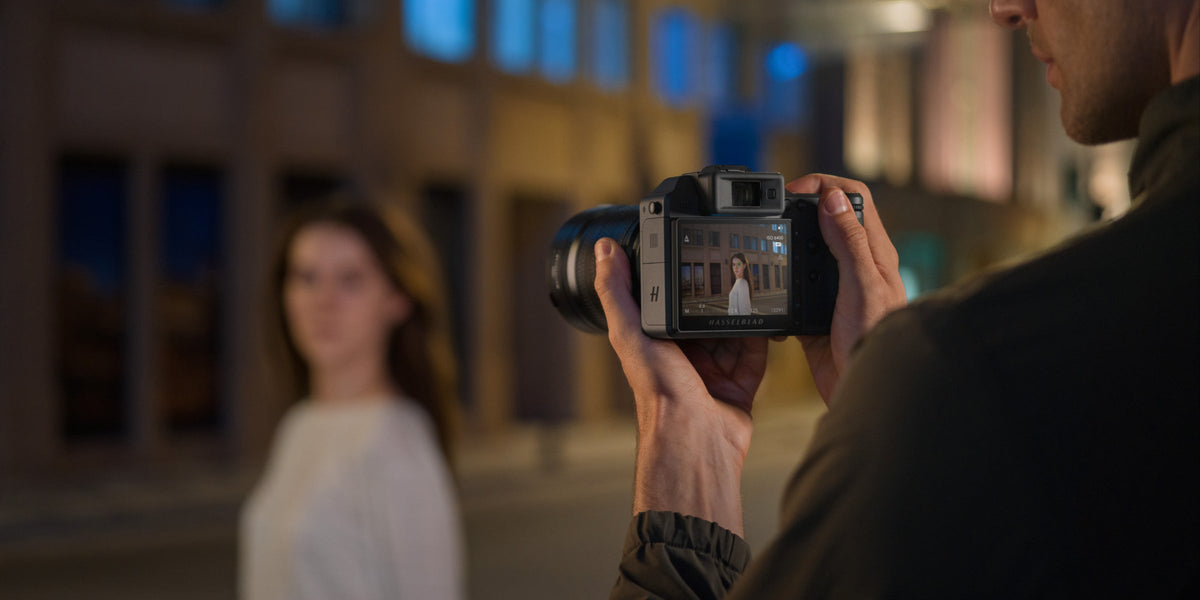
For a relatively still single portrait, start around f/2.8 to f/4, 1/200 to 1/250 second, a low practical ISO, and single autofocus on the nearer eye. For a moving subject, try 1/500 to 1/1000 second and continuous autofocus when the camera and lens support it.
Adjust aperture for the depth of field you need, shutter speed for subject movement, ISO to complete the exposure, and focus mode according to how the subject moves. Focal length, camera distance, pose, lighting, and subject placement can all change the settings that work for a particular portrait.
Quick Reference: Portrait Photography Settings by Situation
Use these values as starting points, then adjust them according to depth of field, subject movement, and available light.
|
Portrait Situation |
Aperture |
Shutter Speed |
ISO |
Focus |
|
Still single portrait |
f/2.8 to f/4 |
1/200 to 1/250 sec |
Low practical ISO |
Single AF |
|
Three-quarter portrait |
f/4 to f/5.6 |
1/250 to 1/500 sec |
As required |
Nearer eye |
|
Natural pose changes |
f/4 to f/5.6 |
1/320 to 1/500 sec |
As required |
AF-C when supported |
|
Walking portrait |
Around f/4 to f/5.6 |
1/500 to 1/1000 sec |
As required |
AF-C with subject detection when supported |
|
Two people on a similar plane |
f/4 to f/5.6 |
1/250 sec or faster |
As required |
Focus on the shared plane |
|
Two people at different distances |
f/5.6 to f/8 |
1/250 sec or faster |
As required |
Check both faces |
|
Small group |
Around f/8 |
1/250 sec or faster |
As required |
Keep faces close to one plane |
|
Environmental portrait |
f/4 to f/8 |
1/250 sec or faster |
As required |
Prioritize the subject |
|
Portrait with flash |
f/4 to f/8 |
Based on ambient light and flash sync |
Low practical ISO |
Based on subject movement |
How to Choose Camera Settings for Portraits
Choose portrait camera settings in this order: aperture for depth, shutter speed for movement, ISO for exposure, and focus mode for subject behavior.
1. Choose Aperture for the Depth You Need
Start around f/2.8 to f/4 for a frontal single portrait. Move toward f/4 to f/5.6 for a three-quarter face, and consider f/5.6 to f/8 when multiple faces occupy different distances from the camera.
Before changing aperture, check:
-
whether one or both eyes need to remain clear
-
whether the subject faces the camera or turns at an angle
-
whether multiple people occupy a similar focus plane
-
camera-to-subject distance
-
subject-to-background distance
2. Set Shutter Speed for Subject Movement
Start around 1/200 to 1/250 second for a relatively still subject.
Increase shutter speed as movement increases:
-
1/320 to 1/500 sec for head turns and natural pose changes
-
1/500 to 1/1000 sec for walking
-
Faster speeds may help when movement becomes more abrupt
If subject movement is visible, raising ISO may preserve sharpness more effectively than lowering shutter speed to maintain a lower ISO.
3. Set ISO After Aperture and Shutter Speed
Set the aperture and shutter speed required by the portrait, then choose an ISO that provides the intended exposure.
A practical sequence is:
-
Set aperture for the required depth.
-
Set shutter speed for subject movement.
-
Begin with a relatively low ISO.
-
Raise ISO as needed for the exposure.
If a moving portrait requires f/4 and 1/500 second, increasing ISO may be preferable to dropping to 1/125 second and introducing visible subject movement.
4. Match Focus Mode to the Subject
Use single autofocus for a controlled subject who stays in position. Use continuous autofocus when the camera supports it and the subject changes distance repeatedly.
Continuous autofocus is particularly useful when the subject:
-
walks
-
turns repeatedly
-
leans toward or away from the camera
-
shifts position between frames
With shallow depth of field and an angled face, placing focus on the nearer eye is a useful starting point.

@ Zhenglin Li
What Aperture Should You Use for Portraits?
Choose an aperture that keeps the important facial features within the depth of field you want. f/2.8 to f/5.6 provides a practical starting range for many single portraits, while f/5.6 to f/8 can provide additional depth for couples or groups arranged at different distances.
Single Portraits
For a frontal head-and-shoulders portrait, start around f/2.8 to f/4.
For a three-quarter face, try f/4 to f/5.6 when both eyes need to remain clear.
If the nearer eye is sharp but the farther eye is softer than intended:
-
stop down by about one stop
-
reduce the face angle
-
increase camera-to-subject distance
Each adjustment changes depth differently, so evaluate the face rather than relying on the aperture value alone.
Couples and Groups
Choose aperture according to how far the subjects are separated in depth.
For two people standing at similar distances from the camera, start around f/4 to f/5.6. If one person stands noticeably behind the other, try f/5.6 to f/8.
For a small group, around f/8 provides a useful starting point. Bringing important faces closer to a similar plane can reduce the depth required.
Background Separation
Increase subject-to-background distance before relying on a wider aperture alone.
If the background still draws too much attention:
-
move the subject farther from the background
-
consider a longer focal length if the composition allows
-
adjust camera position while preserving the intended perspective
-
refine aperture after the composition is established
The XCD 2,8-4/35-100E covers an approximately 28 to 76mm full-frame-equivalent field of view. Its maximum aperture changes from f/2.8 at the wide end to f/4 at the telephoto end, allowing one lens to move from environmental portrait framing toward tighter compositions.
[cta: https://store-na.hasselblad.com/products/xcd-2-8-4-35-100e]
What Shutter Speed Should You Use for Portraits?
Try 1/200 to 1/250 second for relatively still subjects, 1/320 to 1/500 second for natural movement, and 1/500 to 1/1000 second for walking portraits.
Still Subjects
Start around 1/250 second for a handheld portrait.
If both camera and subject remain stable, 1/200 second may also work. Inspect the eyes and other fine facial details rather than judging sharpness from the overall frame alone.
Natural Movement and Changing Poses
Try 1/320 to 1/500 second when the subject is:
-
turning the head
-
changing expression
-
moving the hands
-
shifting posture
If focus appears accurate but some frames are softer than others, increase shutter speed before changing aperture.
Walking and More Active Portraits
Start around 1/500 second for slower walking and move toward 1/800 to 1/1000 second as movement increases.
Movement toward or away from the camera also places greater demands on autofocus. When available, continuous autofocus can help the camera respond as subject distance changes.
Camera Movement vs. Subject Movement
Image stabilization can reduce blur caused by camera movement. It does not freeze movement in the subject.
The X2D II 100C features 5-axis, 10-stop in-body image stabilization and supports AF-C continuous autofocus with subject detection, including human subjects. These functions can support handheld portrait work, while shutter speed still needs to account for movement in the person being photographed.
[cta: https://store-na.hasselblad.com/products/907x-cfv-100c]
What ISO Should You Use for Portraits?
Choose an ISO that supports the aperture, shutter speed, and exposure the portrait requires.
A practical approach is:
-
Bright outdoor light: begin with a relatively low ISO and adjust if the selected aperture and shutter speed require more sensitivity
-
Window light: raise ISO when maintaining the required shutter speed becomes difficult
-
Indoor available light: protect the shutter speed needed for the subject before reducing ISO
-
Walking portraits: allow ISO to rise when needed to maintain around 1/500 second or faster
For example, if you have already selected:
-
f/4 for the required facial depth
-
1/500 sec for subject movement
and the image is underexposed, raising ISO preserves those two creative decisions.

@Emanuele Di Mare
How Should You Focus for Portrait Photography?
Place focus on the facial detail that needs the greatest clarity, then select a focus method that matches the subject's movement.
Focus on the Nearer Eye
For a face turned away from the camera, the nearer eye provides a useful focus point when depth of field is shallow.
If the farther eye falls outside the intended depth, adjust aperture, face angle, or camera distance. Moving the focus point between the eyes does not necessarily provide enough depth to keep both clear.
Use Single Autofocus for Controlled Portraits
Single autofocus works well when the subject holds a position between frames.
The 907X & CFV 100C features Phase Detection Autofocus and Face Detection. Its available focus methods are Single Point and Face Detection, and the camera does not support continuous autofocus.
This makes it relevant to controlled portrait situations in which the subject remains relatively stable and the photographer can place focus deliberately.
[cta: https://store-na.hasselblad.com/products/907x-cfv-100c]
Use Continuous Autofocus for Moving Portraits
Use AF-C when the camera and lens support it and the subject repeatedly changes distance from the camera.
The X2D II 100C supports AF-C continuous autofocus. In AF-S, 425 PDAF zones across the 100MP sensor work with LiDAR for focusing. The camera's subject detection can detect and track human subjects in AF-C.
The XCD 2,8-4/35-100E is among the lenses Hasselblad lists as compatible with AF-C on the X2D II 100C when the required lens firmware is installed. AF-C is not available when using the electronic shutter.
For a walking portrait, try:
-
AF-C
-
human subject detection
-
1/500 to 1/1000 sec
-
an aperture that gives the face sufficient depth
-
ISO adjusted to complete the exposure
How Medium Format Changes Portrait Camera Settings
Medium format affects the combination of focal length, camera distance, framing, and depth of field used to create a portrait, so aperture should be evaluated after composition is established.
Use this sequence:
-
Decide how much of the subject and environment should appear.
-
Choose the camera position for the intended perspective.
-
Select the focal length for the framing.
-
Choose aperture for the required facial depth.
-
Set shutter speed for movement.
-
Adjust ISO for exposure.
An aperture value copied from a different camera format may not produce the same visual result because focal length, camera distance, and framing may also change.
With the XCD 2,8-4/35-100E, the approximately 28 to 76mm equivalent range can cover wider environmental portraits, half-length compositions, and tighter framing. Reassess aperture as focal length, distance, and composition change.

@Junsong He
Portrait Camera Settings for Common Shooting Situations
Use the following combinations as working starting points and refine them according to the actual subject and light.
Indoor and Window-Light Portraits
Start around:
-
Aperture: f/2.8 to f/4
-
Shutter speed: 1/250 sec
-
ISO: adjust for exposure
-
Focus: single AF for a still subject, AF-C when supported and the subject moves continuously
If 1/250 second still produces visible subject movement, try 1/320 or 1/500 second and raise ISO as needed.
If facial depth is too shallow, move from f/2.8 toward f/4 or f/5.6.
Outdoor Portraits
Start around:
-
Aperture: f/2.8 to f/4 for a single subject
-
Shutter speed: 1/250 to 1/500 sec
-
ISO: relatively low when light permits
-
Focus: selected according to subject movement
If the background remains distracting, increase subject-to-background distance or adjust focal length before opening the aperture further.
Moving Portraits
Start around:
-
Aperture: f/4
-
Shutter speed: 1/500 to 1/1000 sec
-
ISO: adjust as needed
-
Focus: AF-C with human subject detection when supported
If the subject moves toward the camera, try the faster part of the shutter-speed range.
If the subject is sharp but the background remains too prominent, change subject-to-background distance, focal length, or framing before reducing depth of field further.
Couples and Group Portraits
For two people at similar distances from the camera, start around:
-
Aperture: f/4 to f/5.6
-
Shutter speed: 1/250 sec or faster
-
Focus: place focus according to the shared facial plane
When subjects are staggered in depth:
-
try f/5.6 to f/8
-
bring faces closer to a similar plane when composition allows
-
check both the closer and farther important faces
For a small group, around f/8 provides a practical starting point.
Portraits With Flash
Set aperture for depth first, then balance ambient light and flash.
A practical sequence is:
-
Choose aperture for the required depth.
-
Set a relatively low ISO when the light allows.
-
Adjust shutter speed for the intended ambient brightness.
-
Set flash output for the subject.
-
Check skin exposure and important highlights.
-
Refine flash power, distance, or modifier position as needed.
The XCD 2,8-4/35-100E uses an integrated leaf shutter with a shutter-speed range from 1/4000 second to 68 minutes and supports flash synchronization throughout that range. This provides additional flexibility when balancing fill flash with bright ambient light or using a wider aperture outdoors.

@Junsong He
How to Fix Common Portrait Setting Problems
Identify whether the problem comes from depth, movement, focus, or exposure before changing unrelated settings.
|
Problem |
Adjustment to Try First |
|
Nearer eye is sharp, farther eye is too soft |
Stop down from f/2.8 toward f/4 or f/5.6 |
|
Both eyes look soft |
Check focus placement, then try a faster shutter speed |
|
Subject is blurred while the background is sharp |
Increase shutter speed |
|
Camera movement is visible |
Increase shutter speed or improve camera support |
|
Moving subject loses focus |
Use AF-C and subject detection when supported |
|
Two people are not both sharp |
Bring faces closer to a shared plane or stop down |
|
Group depth is insufficient at f/5.6 |
Try f/8 |
|
Background is too distracting |
Increase subject-to-background distance |
|
Image becomes underexposed after raising shutter speed |
Increase ISO |
|
ISO is higher than needed for the scene |
Reduce ISO if shutter speed can remain sufficient for movement |
|
Outdoor flash leaves the background brighter than intended |
Adjust shutter speed within the supported flash-sync range |
|
Subject separation is limited |
Adjust subject position, background distance, focal length, or aperture |
Frequently Asked Questions About Portrait Photography Settings
Should I Use Manual Mode or Aperture Priority for Portraits?
Manual mode works well when lighting remains consistent and you want exposure settings to stay fixed. Aperture priority can be useful when light changes quickly, provided you monitor shutter speed so subject movement does not introduce unwanted blur.
Is Auto ISO Useful for Portrait Photography?
Auto ISO can be useful when aperture and shutter speed need to remain within selected ranges while lighting changes. A suitable minimum shutter speed and ISO limit can help balance subject sharpness, exposure, and sensitivity.
Which Metering Mode Should You Use for Portrait Photography?
Multi-zone or evaluative metering provides a practical starting point for many portraits because it evaluates a wider area of the frame. Spot metering can be useful when the subject and background differ substantially in brightness.
Should You Expose for Skin Tones or Protect the Highlights?
Aim for natural skin exposure while retaining important highlight detail. The balance depends on the lighting, skin tone, background brightness, available dynamic range, and intended processing, so the appropriate exposure can vary between scenes.