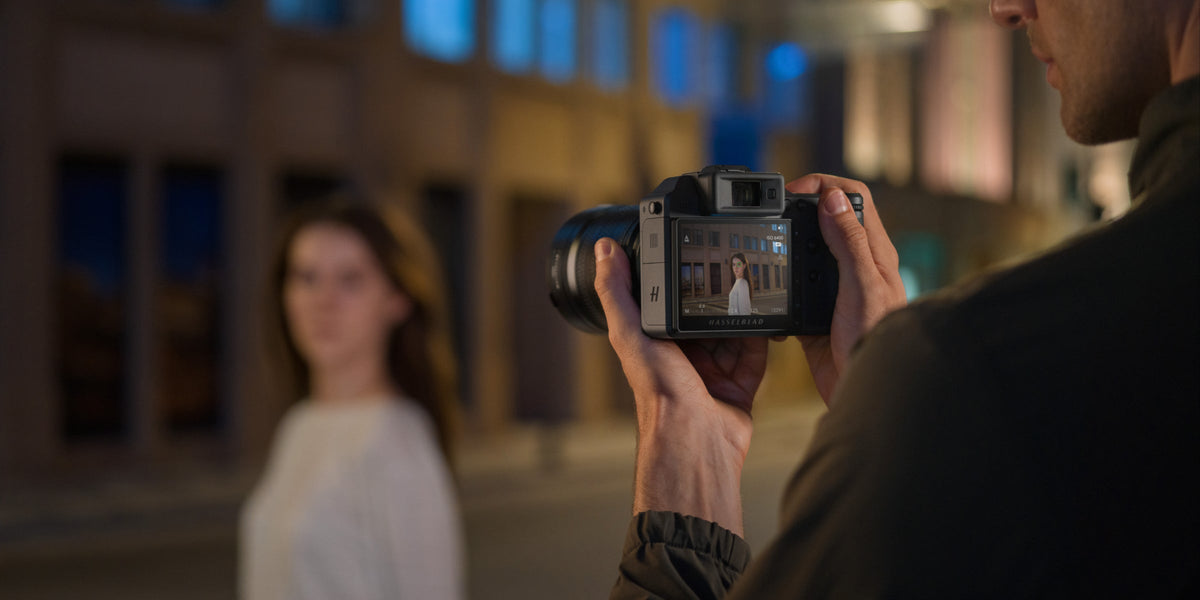
A portrait lens is not defined by one focal length. The choice begins with the portrait itself: how much of the person should enter the frame, how close the camera should be, and whether the surroundings are part of the image.
Once those decisions are clear, focal length becomes a way to complete the composition from the chosen camera position.
This distinction matters because focal length and perspective are often treated as the same thing. They are not. Camera position determines perspective. Focal length determines how much of the scene fits into the frame from that position.
Instead of beginning with whether 50mm or 85mm is better for portraits, consider the decisions in this order:
-
Decide what the portrait should include.
-
Choose a camera distance that gives the perspective you want.
-
Select a focal length that creates the required framing from that position.
-
Check whether the location provides enough working room.
-
Refine the background with distance, focal length, and aperture.
-
Decide whether a prime or zoom better suits the way the session will develop.
-
When working across sensor formats, compare equivalent fields of view rather than focal-length numbers alone.
This approach makes lens choice part of the photographic process rather than a rule about which focal length belongs to portraiture.
Start With the Portrait You Want to Make
Begin by deciding how much of the person and the surroundings should contribute to the image. That decision gives focal length a purpose.
An environmental portrait may depend on a studio, home, street, or workplace. A full-length portrait brings posture, clothing, and gesture forward while still allowing the surroundings to contribute. A head-and-shoulders portrait gives expression greater visual weight. A tighter portrait can reduce the environment to color, tone, and shape.
Before choosing a camera lens for portraits, consider:
-
Does the location tell us something about the person?
-
Should posture and gesture remain visible?
-
Is expression the central subject?
-
How close do you want to work?
-
Should the background remain recognizable or become more abstract?
-
Will the composition stay consistent throughout the session?
These questions establish what the frame needs before a focal-length number enters the decision.

@Emanuele Di Mare
Environmental Portraits
In an environmental portrait, the surroundings carry information.
A studio can reveal how an artist works. Architecture can establish place. Objects can suggest profession, routine, or personality.
A wider field of view gives those elements room to remain part of the portrait rather than reducing them to background.
Full-Length and Half-Length Portraits
As the frame becomes tighter, the balance changes.
Posture, hands, clothing, and expression take on more visual weight, while the environment becomes more selective. A standard or moderately narrow field of view can preserve context while giving the person greater presence.
Head-and-Shoulders and Close Portraits
A close portrait asks the face to carry more of the image.
Expression, light, skin tone, eye contact, and small changes in posture become increasingly important. Less surrounding information is usually needed, which can lead toward a narrower field of view and greater working distance.
These are not fixed categories. They are ways to clarify what the frame is being asked to hold.
Choose Camera Distance Before Focal Length
Camera distance determines perspective, so establish the camera position before using focal length to complete the framing.
Move closer to a face and the nearest features become proportionally closer to the camera than those farther away. The nose, for example, may appear more prominent relative to the ears.
Step farther back and those relative differences become smaller. Facial proportions take on a more restrained sense of depth.
This is why two lenses can produce noticeably different portraits even when the subject occupies the same amount of the final frame. To maintain that framing, the photographer normally changes camera position.
The perspective change comes from that movement.
A Simple Way to Judge Camera Distance
Before settling on focal length:
-
Look at the subject from the distance at which you expect to photograph.
-
Consider how the face, body, and surroundings relate from that position.
-
Move closer or farther away until the perspective suits the portrait.
-
Choose the focal length that gives you the framing you want from that distance.
This keeps camera position as a deliberate photographic choice rather than allowing the lens to decide where the photographer stands.
Distance Also Changes the Relationship With the Subject
Working distance affects more than perspective.
At a relatively close distance, conversation can remain immediate. Small directions can be given quietly, and subtle changes in expression may be easier to observe.
Working farther away gives the person more physical space. For some subjects, the camera may feel less present, although communication can also become less immediate.
The appropriate distance depends on the person, the setting, and the character of the portrait.

@Emanuele Di Mare
Choose Focal Length to Frame the Portrait From That Distance
Once camera position is established, focal length determines how much of the person and surrounding space enters the frame.
Within the same camera format, a shorter focal length provides a wider field of view. A longer focal length provides a narrower one.
If the camera stays in the same position, changing focal length changes framing while geometric perspective remains essentially unchanged.
Suppose the photographer has found a distance that gives the intended facial perspective and feels comfortable for the subject. From that position:
-
a wider field of view can include more body and surroundings
-
a standard field of view can balance person and place
-
a narrower field of view can direct more attention toward expression and detail
Focal length becomes most useful when treated as a framing decision.
Match Focal Length to Portrait Framing
Different focal lengths become useful when they are connected to framing rather than treated as fixed portrait rules.
The ranges below use 35mm full-frame-equivalent focal lengths as a common reference.
|
Portrait Framing |
Useful Starting Range |
What the Frame Emphasizes |
|
Environmental portrait |
About 28-40mm |
Person, place, and context |
|
Full-length portrait |
About 35-55mm |
Body, gesture, and surroundings |
|
Half-length portrait |
About 45-70mm |
Expression, posture, and controlled context |
|
Head-and-shoulders portrait |
About 60-90mm |
Expression with less surrounding space |
|
Tight portrait |
About 70-105mm and longer |
Facial detail and a more selective background |
These ranges provide a starting point. Available space, subject distance, background placement, sensor format, and the intended relationship with the subject can all shift the choice.
Wider Focal Lengths
A wider portrait photography lens keeps more of the environment visible.
Around the 28-40mm-equivalent range, it becomes easier to photograph a person together with a room, street, landscape, or workspace.
Camera distance remains important. Moving very close simply to make the face larger in the frame creates a more pronounced perspective.
For an environmental portrait, staying farther back and allowing the wider field of view to include context can create a more deliberate relationship between person and place.
Standard Focal Lengths
Around 40-60mm equivalent, the person can occupy more of the frame while the setting still has a role.
This range can work naturally for full-length and half-length portraits where expression, posture, clothing, and environment all contribute.
Moderate Telephoto Focal Lengths
Around 60-90mm equivalent, the field of view becomes more selective.
For the same subject framing, photographers generally work farther away than they would with a wider lens. This can suit head-and-shoulders portraits and closer compositions where expression carries more of the image.
The familiar use of 85mm on full-frame cameras comes from this relationship between framing and working distance. It is a useful reference rather than a universal portrait standard.
Longer Focal Lengths
Longer focal lengths can reduce how much of the background enters the composition, provided the location offers enough working distance.
They can suit tighter portraits and larger locations, while the increased camera-to-subject distance also changes the interaction between photographer and subject.

@Junsong He
Make Sure the Location Gives You Enough Working Distance
Available space can become the practical limit on focal-length choice.
A longer focal length generally requires the camera to move farther back to maintain the same framing.
Outdoors or in a large studio, that may be straightforward. In a home, office, hotel room, or compact studio, the wall behind the photographer may become the limiting factor.
|
Shooting Space |
Lens Consideration |
|
Tight interior |
A wider or standard field of view can provide more framing room |
|
Moderate studio |
Standard through moderate telephoto can cover a broad range of portraits |
|
Large studio |
Longer working distances become easier to accommodate |
|
Outdoor location |
Background and framing may carry more weight than physical space |
A familiar portrait focal length is less useful if the room forces the camera into a position that does not suit the subject.
If an 85mm-equivalent field of view requires more space than the location provides, a wider lens used from a more deliberate position may make more sense.
Control the Background With Distance, Focal Length, and Aperture
Background separation comes from several variables working together, rather than maximum aperture alone.
Four controls matter:
-
camera-to-subject distance
-
subject-to-background distance
-
focal length
-
aperture
This gives the photographer more options than simply opening the lens as wide as possible.
Start With Subject-to-Background Distance
Moving the person farther from the background can increase background blur without changing the lens or aperture.
This can be useful when a location provides enough depth to separate the subject from walls, foliage, architecture, or other visual elements.
Then Consider Camera Position and Focal Length
What is often described as background compression is closely connected to camera position.
If a photographer uses a longer focal length and steps farther back to keep the subject the same size in the frame, the perspective relationship between subject and background changes. From the greater distance, the background can appear larger relative to the subject.
Focal length then determines how much of that view enters the frame.
A useful sequence is:
camera position → perspective → focal length → framing
rather than treating focal length alone as the source of perspective.
Use Aperture to Refine the Result
Once distance and composition are established, aperture can refine depth of field.
A wider aperture can soften the background and emphasize the subject. A smaller aperture may better serve:
-
portraits where both eyes need greater depth of field
-
subjects photographed at an angle
-
full-length portraits where clothing and gesture should remain clear
-
portraits involving more than one person
-
environmental work where some context should remain legible
The useful question is not how much blur the lens can create. It is how much visual information the portrait needs.

@Xu Ning
Choose a Prime or Zoom for the Way You Work
Prime and zoom lenses support different working rhythms, so the choice depends on how the portrait session develops.
A Prime Encourages Consistency
A prime gives the photographer one field of view.
With repeated use, that view becomes familiar. The photographer can begin to anticipate the working distance for a half-length portrait, where the edges of the frame will fall, and how much environment will remain before raising the camera.
That consistency can support a portrait series with a coherent visual language.
A Zoom Lets the Frame Change Without Changing Camera Position
A zoom offers a different kind of control.
Imagine that the camera is already at a distance that gives the intended facial perspective and maintains a comfortable relationship with the subject.
From that position, changing focal length can move between environmental, full-length, half-length, and head-and-shoulders framing without requiring the photographer to continually move closer and farther away.
Because camera position remains unchanged, geometric perspective remains essentially consistent while framing changes.
This can be useful when the portrait develops quickly or when changing position or lenses would interrupt the interaction.
Translate Portrait Focal Lengths to Medium Format
When choosing a medium format portrait lens, compare equivalent fields of view rather than transferring full-frame focal-length numbers directly.
Focal length is a physical property of the lens. Sensor size changes the field of view produced by that focal length.
A 90mm XCD lens therefore does not frame the scene in the same way as a 90mm lens on a 35mm full-frame camera.
Within the X System:
|
XCD Lens |
Physical Focal Length |
35mm Full-Frame-Equivalent Focal Length |
|
XCD 2,5/38V |
38mm |
30mm |
|
XCD 2,5/55V |
55mm |
43mm |
|
XCD 3,4/75P |
75mm |
59mm |
|
XCD 2,5/90V |
90mm |
71mm |
|
XCD 2,8-4/35-100E |
36-97mm |
28-76mm |
Equivalent focal length provides a familiar way to compare field of view across formats. It does not mean that an XCD 90mm becomes a 71mm lens. It remains a 90mm lens and gives an angle of view comparable to approximately 71mm on a 35mm full-frame system.
This distinction makes familiar portrait references easier to translate when choosing a medium format portrait lens.
Choose an XCD Lens for Your Portrait Style
The XCD lens choice follows the portrait decisions already made: how much environment matters, how close you want to work, and how much the framing may change during the session.
XCD 2,5/38V: When the Setting Carries Meaning
The XCD 2,5/38V has a 30mm full-frame-equivalent focal length.
Its wider field of view can include more environmental detail around the subject. This makes it relevant when a room, workspace, street, landscape, or architectural setting contributes to the portrait rather than simply sitting behind it.
The wider view gives the frame room to describe the relationship between person and place.
[cta: https://store-na.hasselblad.com/products/xcd-38]
XCD 2,5/55V: When Person and Place Need Balance
The XCD 2,5/55V has a 43mm full-frame-equivalent focal length.
Its field of view suits full-length and half-length portraits where gesture, clothing, expression, and surrounding context all matter. Its f/2.5 maximum aperture also provides control over depth of field when the background should recede while the setting remains part of the photograph.
[cta: https://store-na.hasselblad.com/products/xcd-55]
XCD 3,4/75P: When the Frame Becomes More Selective
The XCD 3,4/75P has a 59mm full-frame-equivalent focal length.
This places it between standard and moderate telephoto territory. For portrait work, that narrower field of view can give the person greater visual weight while still leaving room for selected environmental context.
[cta: https://store-na.hasselblad.com/products/xcd-75p]
XCD 2,5/90V: When Expression Carries More of the Image
The XCD 2,5/90V has a 71mm full-frame-equivalent focal length and an f/2.5 maximum aperture.
Its moderate telephoto field of view suits closer portrait framing where expression, facial detail, light, and tonal transitions carry more of the composition. It also allows tighter framing from a greater camera-to-subject distance than a standard lens.
[cta: https://store-na.hasselblad.com/products/xcd-90]
XCD 2,8-4/35-100E: When the Portrait Changes During the Session
The XCD 2,8-4/35-100E has an actual focal-length range of 36-97mm and a 28-76mm full-frame-equivalent range.
Its range extends from wide-angle through standard framing to moderate telephoto. Within a portrait session, that allows the composition to move from person-and-place images toward tighter portraits without changing lenses.
When the camera-to-subject distance is already working, adjusting focal length can change the framing while preserving the established perspective and interaction.
[cta: https://store-na.hasselblad.com/products/xcd-2-8-4-35-100e]
A Simple Portrait Lens Decision Guide
The lens becomes easier to choose when each decision is made in sequence.
1. Decide What the Portrait Needs to Include
Ask whether the photograph is primarily about:
-
person and place
-
posture and gesture
-
expression
-
facial detail
This establishes how wide or selective the frame needs to be.
2. Choose the Camera Distance
Find a distance that gives the facial perspective you want and supports the way you want to interact with the subject.
3. Choose the Framing
Decide whether the image will be environmental, full-length, half-length, head-and-shoulders, or tighter.
4. Select the Field of View
Choose the focal length that creates that framing from the selected camera position.
5. Check the Physical Space
Confirm that the room or location supports the required working distance.
If space is limited, reconsider the field of view rather than allowing the location to determine camera position unintentionally.
6. Refine the Background
Work with:
-
subject-to-background distance
-
camera position
-
focal length
-
aperture
as connected controls.
7. Decide Whether the Session Needs a Prime or Zoom
A prime can support a consistent field of view.
A zoom can support changing framing while keeping the camera-to-subject relationship relatively stable.
8. Translate the Choice to Your Camera Format
When working with medium format, use equivalent focal length to translate familiar full-frame fields of view.
|
Question |
What It Helps Determine |
|
How much of the environment matters? |
Wider or narrower field of view |
|
How much of the person belongs in the frame? |
Required framing |
|
How close should the camera be? |
Camera position and perspective |
|
How much room is available? |
Practical working distance |
|
How much should the background recede? |
Distance, focal length, and aperture |
|
Will framing change during the session? |
Prime or zoom workflow |
|
Which sensor format are you using? |
Equivalent field of view |
|
Which XCD lens supports those choices? |
Lens selection |
A portrait lens gives the photographer a field of view within which distance, expression, light, gesture, and place can be arranged with intention.
Frequently Asked Questions
Can a Macro Lens Be Used for Portrait Photography?
Yes. A macro lens can work for portraits when its focal length, working distance, and rendering suit the image. High resolving power does not make a lens unsuitable for people. Lighting, contrast, focus, skin treatment, and post-processing all influence how fine detail appears.
Does Minimum Focusing Distance Matter for Portrait Photography?
It can. Minimum focusing distance becomes more relevant when a session includes tight facial details, hands, jewelry, or objects connected to the subject. For conventional head-and-shoulders portraits, camera position and perspective often have more influence on lens choice.
Can a Portrait Lens Be Too Sharp?
Sharpness itself does not make a lens unsuitable for portraiture. The appearance of a portrait also depends on contrast, light, focus transition, depth of field, color, and post-processing. The more useful question is how the lens renders the details that matter to the image.